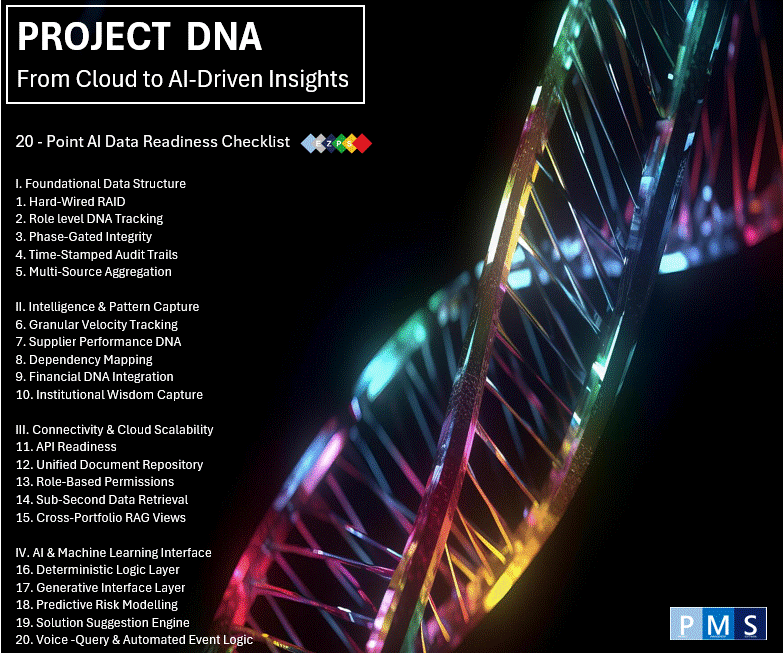
Operational Truth Layer – The Missing Link Between AI and Better Business Decisions
Q: Everyone seems to be talking about AI Agents, Copilots and Autonomous Enterprises. Why do we talk about an Operational Truth Layer?
Because intelligence alone doesn't improve organisations.
For AI to make meaningful recommendations, it first needs a trusted understanding of what is actually happening across the business.
An AI agent can analyse schedules, identify risks, recommend actions and optimise workflows.
But before it can do any of those things, it needs answers to some very practical questions.
What work has been completed?
Which risks remain open?
Has a milestone actually been achieved?
Has a budget been approved?
Who authorised the change?
These are not AI questions.
They are operational questions.
That is where we believe the concept of an “Operational Truth Layer” becomes increasingly important.
Q: Isn't this simply another way of describing data?
Not quite.
Data is only one part of the picture.
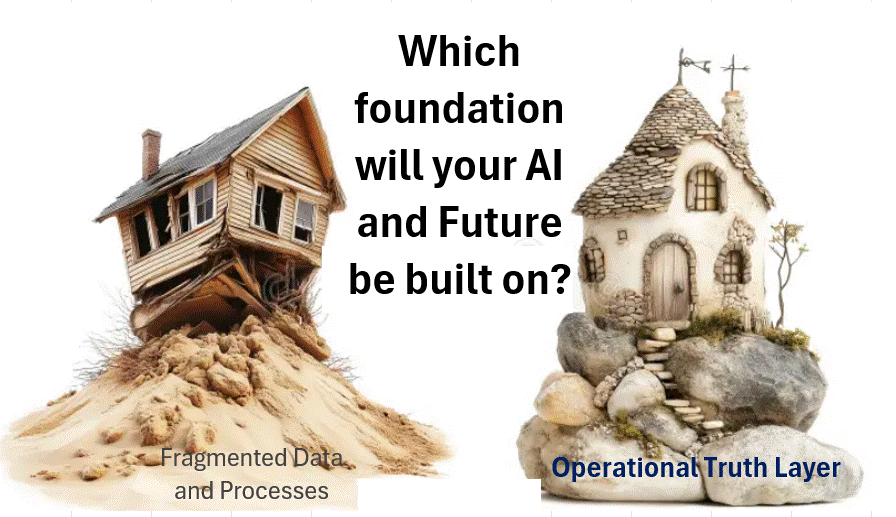
Operational truth is created when trusted data is combined with consistent processes, governance, ownership, accountability and evidence at scale.
Without those foundations, organisations often end up with multiple interpretations of reality.
Project managers may report one status.
Finance another.
Executives another.
AI cannot optimise conflicting versions of the truth.
It requires a trusted operational foundation from which both people and intelligent systems can make informed decisions.
Q: Has this always been your philosophy?
Interestingly, yes. For us it's operational business thinking 101.
Although the language has evolved over time.
Initially our focus was on improving project delivery through better governance, visibility accountability, cross functional teamwork.
Later, the conversation expanded into business intelligence.
Questions became:
"How do executives know what is really happening?"
"How do organisations measure performance?"
"How do they learn from previous projects?"
Today, AI has moved the conversation one step further.
The question is no longer simply:
"How do we manage projects better?"
It is:
"How do organisations continuously improve the quality of their decisions?"
That is a much broader challenge.
Q: Why is this becoming more important now?
Because AI changes the scale and speed of decision making.
For years, organisations could tolerate fragmented systems, spreadsheets and manual workarounds because people spent time reconciling information.
AI exposes those weaknesses.
If information is inconsistent, duplicated or incomplete, intelligent systems simply make decisions faster using poor operational context.
In other words, AI amplifies operational maturity.
It does not replace it.
Q: Does this mean legacy organisations are at a disadvantage?
Not necessarily.
Every organisation begins its AI journey from a different level of operational maturity.
Some already have strong governance, defined ownership and disciplined business processes, certainly top 5% performers in any sector.
Others still rely heavily on spreadsheets, disconnected applications and manual reporting.
The challenge is different for every organisation.
The strategic questions remain remarkably consistent.
Where are we now?
Where do we want to be?
How do we get there?
Answering those questions reliably has always been difficult.
AI doesn't change the questions.
It simply increases the value of answering them well.
Q: So where does project management fit into the future of AI?
We believe project portfolio management remains central.
Projects are where organisations execute strategy.
Unlike purely digital environments, projects involve people, suppliers, governance, approvals, finance, changing priorities and real-world outcomes.
These are environments where judgement, accountability and evidence matter.
Rather than replacing project managers, AI is more likely to become an operational intelligence capability.
Continuously monitoring schedules, milestones, risks, issues, dependencies and financial performance.
Identifying emerging trends.
Highlighting exceptions.
Supporting better decisions.
While people remain accountable for outcomes.
Q: What does this mean for PMS Ltd?
Since publishing our AI Roadmap in June 2023, our vision has remained consistent.
AI should reduce the administration burden.
Improve decision quality.
Accelerate organisational learning.
But always remain grounded in trusted operational truth.
Technology will continue to evolve.
Today's models, agents and tools will inevitably be replaced by more capable systems… we are already working on that to include Six Sigma performance tools.
The enduring challenge for every organisation will remain the same.
How do we create trusted operational knowledge that enables people and AI to learn, decide, govern and continuously improve together?
Perhaps that is the real opportunity of enterprise AI.
Not replacing human judgement.
But strengthening it through trusted operational intelligence.
To find out how we can help you on your business transformation journey, contact us at EZPS